
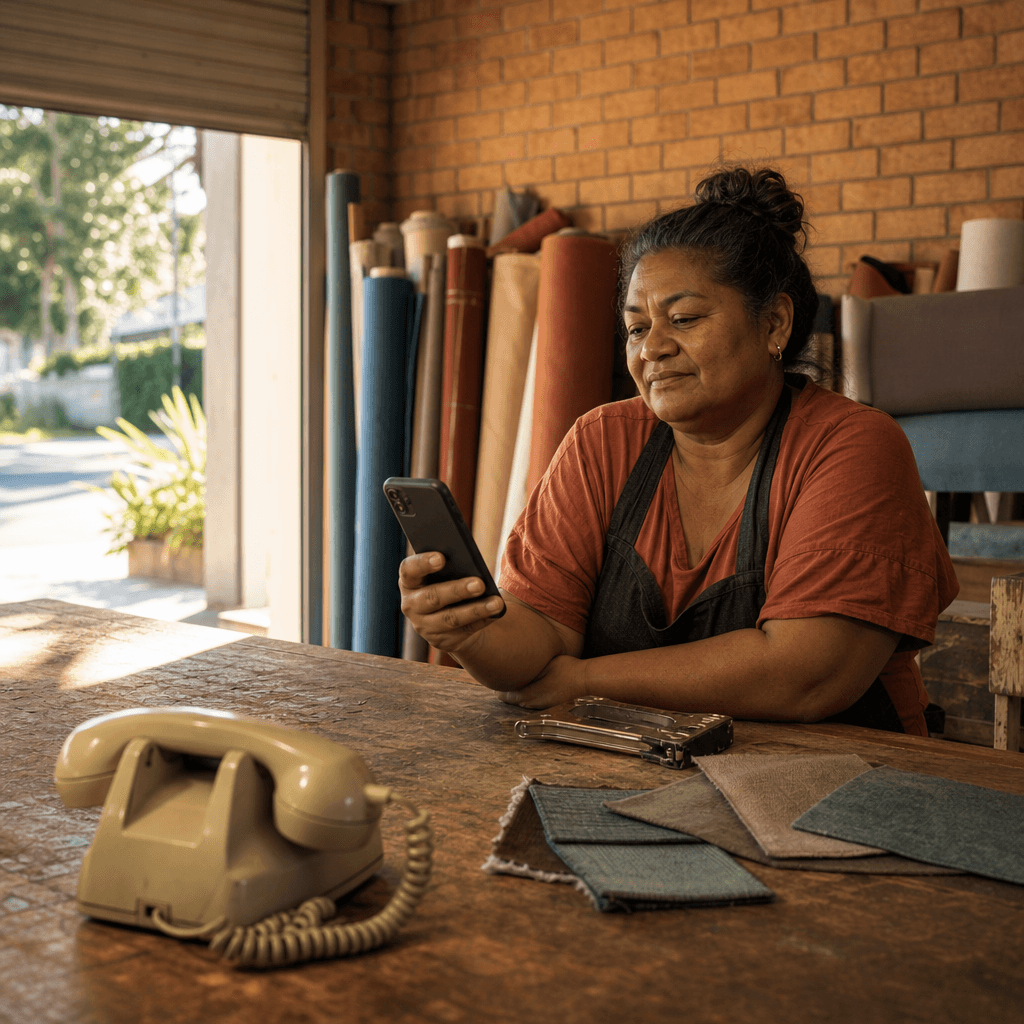
A website costs money. Not having one costs nothing. That is the maths plenty of owners do, and it feels airtight. It is also wrong, because the cost of not having a website never arrives as an invoice. It arrives as phone calls that never ring, quotes that go to someone else and customers who quietly gave up looking.
This post shows you how to put a rough dollar figure on that silent cost, using your own numbers, in under 30 minutes.
Where the cost of not having a website shows up
Nobody emails to say they chose your competitor because you were hard to find. So the loss stays invisible, which is exactly why it feels like zero. Here is where it tends to hide.
- Referrals that stall. A friend recommends you, the next person searches your name, finds a patchy social page or nothing at all, and moves on to the next name on the list.
- Searches you never see. People type things like 'electrician near me' or 'cafe with vegan options' and click the business that answers the question straight away.
- Trust you rebuild by hand. Without somewhere to show your licence, your work and your service area, you spend every phone call proving you are legitimate.
- Enquiries outside your hours. Plenty of people research at 9pm on the couch. If they cannot send a message then, many will not call tomorrow.
Here is a before and after. Before: a customer finds your phone number on a directory, cannot tell what you charge or where you work, and rings three businesses. After: they read your services, see photos of finished jobs, and send an enquiry while you are asleep.
Work out your own number in 20 minutes
You do not need perfect data. You need a sensible estimate you can sanity check. Grab a notepad and work through it.
Step one: count your real enquiries
Look at last month. How many calls, messages and emails turned into a genuine opportunity to quote or sell? Check your phone log, your inbox and your social inbox. Write down one number.
Step two: estimate what you are missing
This is the guess, so be conservative. Think of the referrals that went quiet and the times someone said they could not find you. Ask yourself whether a clear website would bring in even two or three extra enquiries a month. If you are unsure, halve your guess.
Step three: put a value on it
Multiply the extra enquiries by the share you usually win, then by your average job or sale value. Then multiply by twelve.
Picture a plumber in Burleigh. These are made-up numbers, so swap in your own. Four extra enquiries a month, half of them won, at an average job of $450, gives two jobs and $900 a month. That is $10,800 over a year, from a handful of people who would otherwise have rung someone else.
Even if you cut every figure in half, the answer is rarely zero. That is the point of the exercise.
Why Facebook and word of mouth do not cancel the cost
Many owners say their business runs on word of mouth, and fair enough. Referrals are the best leads going. But a referral is a warm introduction, not a finished sale. The person still checks you out before they ring.
A social page can help, but it has limits. You do not control the layout, the algorithm decides who sees your posts, and most people searching for a service will not scroll through months of updates to find your prices or your service area. A page can also vanish or be locked if there is a problem with the account.
A website sits alongside your social pages. It is the one place you own, where the basics are always easy to find. If you want the longer comparison, think of social media as the shopfront window and the website as the shop itself.
The time you spend answering the same questions
Money is not the only cost. Time is the other one, and it is easier to count.
Write down the five questions you answer most often. Typically they are things like: Do you service my suburb? What are your hours? Do you do weekends? How much does it usually cost? How do I book?
If each takes three minutes and you field ten of them a week, that is half an hour of your week, every week, spent repeating yourself. Put those answers on a page and some of those calls never happen. The ones that do come from people who already know the basics and are ready to talk.
Value that half hour at what you charge per hour and the figure adds up faster than you would think.
What the other side of the ledger looks like
To judge whether a website is worth it, you need a fair look at what it costs too. Prices vary a lot depending on the size of the site, who builds it and what support you get, so treat these as typical shapes rather than quotes.
- Domain name and hosting: usually a modest yearly cost, often well under a few hundred dollars for a small site.
- A simple professionally built site: commonly a few thousand dollars upfront, or a monthly plan that spreads the cost out.
- Ongoing care: updates, security and small changes, either bundled into a plan or charged as you go.
Check whether any quote you receive includes GST, and ask what is covered after launch. A clear quote should spell out what you get, what you own and what happens if you want to leave.
Now compare that with your number from earlier. If one or two extra jobs a month would cover the cost, the decision looks very different from the idea that skipping a website saves money.
Mistakes that keep good businesses offline
These are the reasoning traps worth checking yourself against.
- Waiting until it is perfect. A clear, honest site with your services, area, contact details and a few real photos beats a grand plan that never launches.
- Comparing the cheapest price with the dearest outcome. A bargain site nobody can use on a phone costs you as much as no site. Look at what you actually get.
- Counting only the bills you can see. The lost job never shows up in your accounts, so it never feels real. Estimate it anyway.
- Assuming your customers are not online. Even people who ring you often check you out online first, whatever their age.
Things to do this week
- Work out your own lost enquiry number using the three steps above, and keep it conservative.
- Google your business name and your main service plus your suburb. Write down what a stranger would see.
- List the five questions you answer most often, as the start of your website content.
- Ask your last three customers how they found you and what they checked before calling.
- Write down a budget range you could live with, so you can compare quotes calmly.
If your number turned out bigger than you expected, it is worth a chat about what a simple, well-built site would look like for your business. You can see how we approach it on our website design for small business page, and there is no pressure to do anything with that number except know it.